In short重點
YOLO26 ends its backbone with a self-attention block. We replace it with a Mamba core and get a detector that is 2.9% smaller, 12.1% cheaper in FLOPs, and 17.6% faster on CPU — for 0.1 mAP. A placement study across the neck also identifies where an SSM helps, and the relationship is non-monotonic.
YOLO26 的主幹末端接的是自注意力區塊。我們用 Mamba 核心取代它,得到一個參數少 2.9%、FLOPs 少 12.1%、CPU 推論快 17.6% 的偵測器——代價是 0.1 mAP。另有一項位置研究,找出 SSM 置於 neck 何處才有幫助,而兩者的關係並非單調。
The problem問題
YOLO26, released in January 2026, is NMS-free and closes its backbone with C2PSA — a position-sensitive self-attention block wrapped in a cross-stage partial topology. It works, but attention scales quadratically with token count, which is exactly the wrong property for an edge detector.
Several works have integrated SSMs into YOLO necks. Whether Mamba can directly replace the C2PSA block in an NMS-free framework had not been examined, which is the gap this paper addresses.
2026 年 1 月發表的 YOLO26 是 NMS-free 架構,其主幹末端使用 C2PSA—— 一個包在 cross-stage partial 拓樸中的位置敏感自注意力區塊。它確實有效, 但注意力的成本隨 token 數量呈二次方成長,而這正好是邊緣端偵測器最不需要的特性。
先前已有數篇研究將 SSM 整合進 YOLO 的 neck,但 Mamba 能否直接取代 NMS-free 框架中的 C2PSA 區塊,尚未被檢驗——這正是本文要補上的空缺。
The idea作法
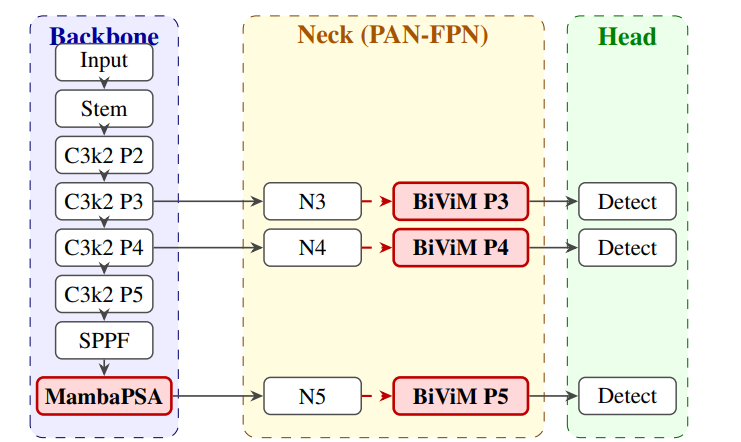
MambaPSA keeps the CSP wrapper and swaps only the internal self-attention branch. A 1 × 1 convolution projects the input into two halves; one half is flattened into tokens and passed through a single lightweight Mamba block (dstate=8, e=1, mono-directional), while the other is carried through by identity. The two are concatenated and projected back. Keeping the Mamba core deliberately small makes the block roughly parameter-neutral against C2PSA, so any measured difference is attributable to the mechanism rather than to capacity.
Separately, a bidirectional Vision Mamba block is inserted at P3, P4, or P5 of the neck — one at a time — to find out where global aggregation pays for itself.
MambaPSA 保留 CSP 外殼,只置換內部的自注意力分支。輸入先經 1 × 1 卷積投影成兩半, 其中一半展平成 token 序列送入單一輕量 Mamba 區塊(dstate=8、e=1、單方向掃描), 另一半則以恆等映射直接通過,最後兩者串接並投影回原通道數。刻意把 Mamba 核心做小, 是為了讓整個區塊相對 C2PSA 在參數量上接近中性——如此一來,量測到的差異才能歸因於機制本身,而非容量。
另一條線是把雙向 Vision Mamba 區塊分別插入 neck 的 P3、P4 或 P5(一次只放一個), 用來找出全域聚合在哪個位置才划算。
Results實驗結果
| Method | Params | GFLOPs | mAP50:95 | CPU FPS |
|---|---|---|---|---|
| YOLO26-n | 2.40M | 5.8 | 49.9 | 17 |
| + P3 BiViM | 2.45M | 6.5 | 48.4 (−1.5) | — |
| + P4 BiViM | 2.63M | 6.2 | 50.8 (+0.9) | — |
| + P5 BiViM | 3.45M | 6.1 | 50.6 (+0.7) | — |
| MambaPSA (ours) | 2.33M | 5.1 | 49.8 (−0.1) | 20 |
| 方法 | 參數量 | GFLOPs | mAP50:95 | CPU FPS |
|---|---|---|---|---|
| YOLO26-n | 2.40M | 5.8 | 49.9 | 17 |
| + P3 BiViM | 2.45M | 6.5 | 48.4 (−1.5) | — |
| + P4 BiViM | 2.63M | 6.2 | 50.8 (+0.9) | — |
| + P5 BiViM | 3.45M | 6.1 | 50.6 (+0.7) | — |
| MambaPSA (ours) | 2.33M | 5.1 | 49.8 (−0.1) | 20 |
The two findings sit on opposite sides of the same trade-off. MambaPSA returns 2.9% of the parameters and 12.1% of the FLOPs at a cost of 0.1 mAP. The P4 placement instead spends 9.6% more parameters to gain +0.9 mAP, the best accuracy per parameter of the three positions.
Placement turns out to be non-monotonic. P3 operates on the highest-resolution feature map and hurts accuracy by 1.5 mAP, which suggests that one-dimensional scanning over fine-grained features disrupts the local spatial structure small-object detection depends on. P5 helps, but costs 43.8% more parameters to do it.
這兩個發現位於同一個權衡的兩端。MambaPSA 歸還了 2.9% 的參數與 12.1% 的 FLOPs, 代價為 0.1 mAP;P4 位置則反過來多花 9.6% 的參數換得 +0.9 mAP,是三個位置中每單位參數效益最好的。
位置的影響並非單調。P3 作用在解析度最高的特徵圖上,反而傷害了 1.5 mAP 的準確度, 這暗示在細粒度特徵上做一維掃描,會破壞小物件偵測所仰賴的局部空間結構。 P5 有幫助,但代價是多出 43.8% 的參數。
Per-class behaviour各類別的表現
Across the 20 VOC categories, MambaPSA gains on animals and large vehicles (bird +2.5, bus +1.8, sheep +1.8) and loses on indoor and elongated structures (diningtable −3.2, boat −2.1, train −1.9). The P4 variant is the most balanced, taking the best score on 9 of 20 classes across both large objects (aeroplane +2.5, train +2.4) and small ones (pottedplant +2.2).
在 VOC 的 20 個類別中,MambaPSA 在動物與大型車輛上有所提升(鳥 +2.5、公車 +1.8、羊 +1.8),在室內物件與細長結構上則退步(餐桌 −3.2、船 −2.1、火車 −1.9)。P4 變體最為均衡,在 20 個類別中有 9 個取得最佳分數,且大物件(飛機 +2.5、火車 +2.4)與小物件(盆栽 +2.2)兼顧。
Limitations限制
All results come from a single training seed. At VOC-nano scale, inter-seed variance can approach the size of the per-variant differences reported here, so these numbers should be read as directional rather than definitive. CPU throughput is likewise a single benchmarking run. Multi-seed stability, alternative runtimes such as ONNX Runtime and OpenVINO, edge-device profiling, and MS COCO validation are all still open.
所有結果都來自單一訓練種子。在 VOC-nano 這個規模下,種子間的變異量可能接近本文各變體之間的差距,因此這些數字應視為方向性的參考,而非定論。CPU 吞吐量同樣只做了單次基準測試。多種子穩定性、ONNX Runtime 與 OpenVINO 等其他推論環境、邊緣裝置的實測,以及 MS COCO 上的驗證,都尚未完成。